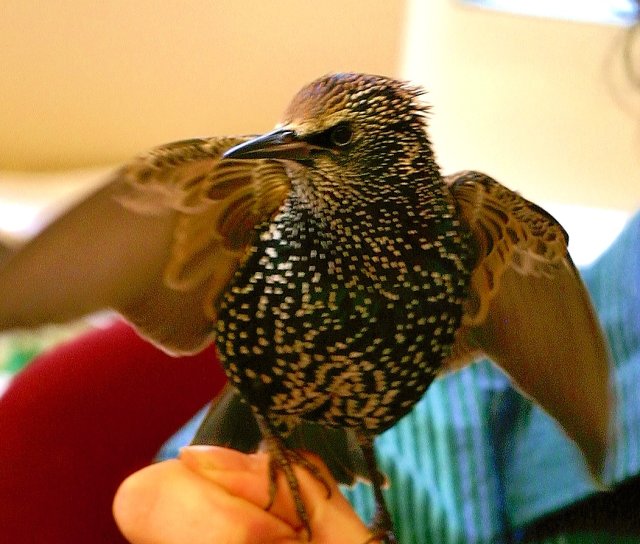
I'm leaving on Monday for Kenya, to study the vocal communications of an African starling species, the superb starling (
Lamprotornis superbus). Like the European starlings I work with in Chicago, superb starlings are highly social. However, the social organization differs greatly between these related species. European starlings live and feed in groups whose size varies extensively over the course of the year. Flocks can have hundreds of thousands of birds in the winter, whereas during breeding season the birds spend most of their time in breeding pairs. Groups mingle extensively, and it's hard to assess how stable the interactions are between individuals. In contrast, superb starlings live in groups that are much more stable and well-defined. They're also cooperative breeders, which implies different roles (breeder or helper) and suggests that interactions between individuals could be of much higher importance.
Superb starling song hasn't received nearly as much attention as the songs of European starlings. I'm collaborating with
Dustin Rubenstein, who's studied superb starlings at the Mpala Research Center for a number of years. I'll be making recordings of the birds singing on their territories. We'll analyze the song to see how it's organized, and then try to correlate variation in the song structure with individual identity, group membership, breeding quality, or social status. It'll be incredibly interesting to see how the song and its role in social organization compares to what we know about European starlings.
It's been a bit hectic here leading up to my departure. Nature Neuroscience rejected the paper we submitted a couple months back, so I've been burning the midnight oil trying to get the manuscript in shape to be resubmitted. The fact that I'm leaving really hasn't sunk in at all yet.