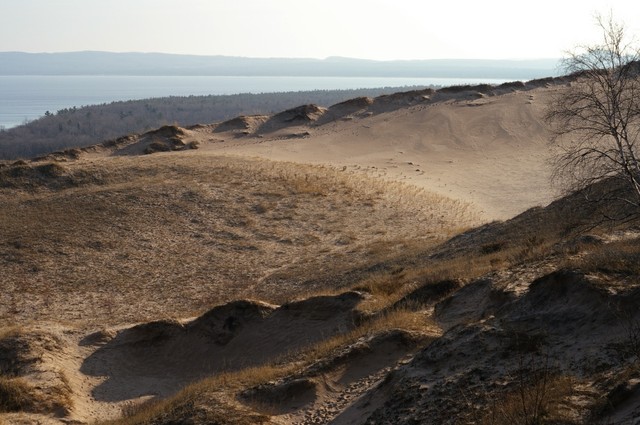
For Buy Nothing Day I went to Sleeping Bear Dunes, up in lower Michigan just west of Traverse Bay. It's about three hundred miles from Chicago, which took about seven hours to drive at my moseying pace. I love these long drives to the edges of the world, swimming up the interstates and their tributaries. I can't say much for small town Michigan. Muskegon, Ludington, Manistee, all seem molded from the same cheap plastic. I watched the town where I grew up follow the same trajectory, from open fields to pavement swarming with angry machines. It used to make me angry too; it used to have power over my own wild spaces. Now I just drive slowly, carrying my peace with me, looking at everything.
The dunes are formed by winds carrying sand over the lakes, where there is nothing to slow them down, until they reach the land and lose velocity. The shape of the dunes already there influences the movements of the wind, so the land shapes itself. This sort of feedback can lead to chaotic behavior: a five hundred foot dune seemingly content with its view will suddenly split in half or wander a hundred feet downwind. In such conditions life's contingency is immediately apparent.
And now it has laid aside its glory, and become small and quiet. Whatever you see is only a trace of its former existence, or its quiet hope for a future existence. It is a wilderness as profound as the emptiest desert. The heart's silences grow.
Knowledge of nature, like all knowledge, requires a setting aside of what had previously passed for truth. Anyone who claims science can be achieved without entering into ignorance and confusion is only a theorist. But in this respect the knowledge of nature differs: it is not only the mind that must be surrendered, but the body as well. If it is not placed, at least a little, at the mercy of the elements and its own needs, the most vital fact will be missed. You cannot even begin to speak the language until you become as vulnerable as the lives that you want to know.