There is a delightful timelessness to this place and this work. The sun rises promptly at 6:20 every morning. You hear a few songs from a thrush or a chat and then the white-browed sparrow weavers start their screeching duets. They're really quite fascinating birds; they live in colonies, in nests built of straw and hung from the branches of acacias. They start their duets with a few faint calls and then work themselves into a brief frenzy that sounds like one bird but turns out to be at least two. Neuroscientists weary of studying zebra finches may find the precise coordination of motor and auditory information fascinating, and I doubt anyone would care much if a few of them disappeared.
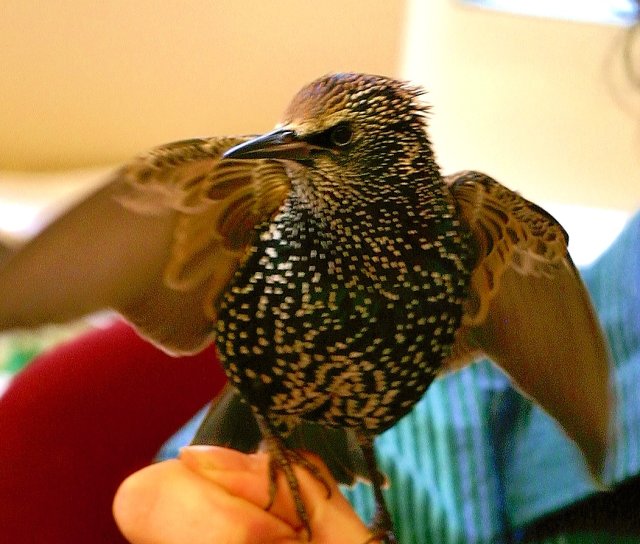
I've spent most of the past two weeks following my superb starlings around on three territories. Their habits seem to vary quite a bit on the different territories, and it generally takes me several weary days of tramping around to get any sense of where they spend their time and, more importantly, where they congregate to sing. The territories are quite a bit larger than I expected; the largest I've worked in is at least 500 meters across, and they fly from one end to the other with infuriating frequency. I'll have snuck up on one bird who looks like he's ready to start saying something, when a couple of his friends will fly overhead making flight calls, and he'll head off to the other end of the territory to see what the fuss is about. Right around lunch time, though, 5 or 6 birds will find a few trees, perch at about midlevel, and start singing for about an hour. Unlike the sparrow weavers, they don't exactly try to synchronize their song, and it's a little tricky to get close enough that I can use my directional microphone to isolate one of the singers. Add to this trying to get inconspicuously into a position where I can also read the colored bands on the bird's legs.
The Cornell undergraduates I came here with, as well Dustin, are leaving tomorrow, and I'll be here for about ten more days. I've done a little bit of analysis, and it looks like it's mostly the males that are singing in these midday choruses, but I still don't know much about the structure of the song and I expect to be looking at spectrograms for some time to come. I've toyed around with developing an automated motif classifier for the European starling songs, and now that I've got another study animal with a ridiculously complex repertoire it may be time to invest a bit more work in that.
I seem to spend most of the rest of my time talking to other researchers at meals, tagging along with them for a half day or so, and going on birding expeditions and game drives. I go to bed around 9 or 10 and wake up feeling totally refreshed. It's a good life here.