29 August - Newport, WA
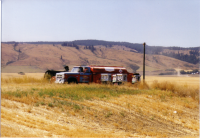
A while back I asked the question, is there any difference between me and someone who only has my memories? The truth is that I really don’t know. Last night I think the answer came in a dream, but I’ve forgotten it, or lost the sense of assurance that permeates most of my dreaming. What remains is that perhaps events leave a mark more indelible and more subtle than memory, that they change the way I think and reason as surely as my 72 mile day on the 27th changed the way I walked, or the way this entire trip will change the structure of my muscles. But this answer remains unsatisfying. My parents picked me up in Wilbur on the 28th and left me here on the border of Idaho today; the landscape exists as surely as if I had bicycled over it. Yet if I had not written this down I might be deceived, even several weeks from now, into thinking I had used my muscles to cross what I only saw through the car window.
I am unconvinced that I change. Yet, I sometimes see in another person’s eyes or gait something like a memory—what I was once or what I might have let myself become: a girl sitting in a park chewing on a pen, a man drinking cheap wine with his date at the Olive Garden. And somehow I wonder if these feelings of dislocation do not proceed from having made myself go up out of the last gully before Coolee City or from the pain and mental exhaustion of riding through rolling hills of dead wheat to Wilbur. I do not know.
Last night I dreamed that I had to debate Curtis Johnson and that halfway through the dinner before the debate I was sitting across from Cameron Diaz. I insisted that she was not in fact Cameron Diaz, only someone much like her. She left Keanu Reeves for me, and as we drove off, either in a convertible or on a tandem bicycle, I told her that my argument in the debate was going to be that it is necessary to know only one thing, and that at some point you must learn to let go of even that. For when you know something, such as position or date or love or hatred, you establish a scale of here and there, less and more; and for something to be truly infinite you must know nothing about it, so that it cannot be measured.
I think it is maybe that memory cannot define us, to borrow from Trinity: the Matrix cannot tell you who you are. Which may be taken on several levels: First, that our twentieth-century matrix—movies, television, even books and what we take to be other people—cannot tell us what to be, or how to be what we are, because they lack reality. Truth alone can tell us that. Second, that sensation does not define reality. The touch or appearance of a thing can be simulated, because what we perceive, and perceive to be real, is provided to us through nerves and synapses that speak to an “I” that cannot be seen at all. To see another person is to see only the object associated with that person—yet is the I of that person any less real than my own? Much of reality is invisible, and what is seen is at least half the creation of the mind.
Thirdly, and perhaps finally, that memory, no matter how vivid, cannot tell us what we are. I am temporal—it is probably ridiculous to suppose that the past alone can give the identity of someone who has yet more time to be experienced. Gene Wolfe suggests that the future makes itself felt on the past, so that the wise man is a wise child, and a doomed man carries his doom on his face always. I say—and this only differs on the trivial point that the future is unknown—that it is the present that describes us, for in the present we are as close to eternity as we have yet to get. What I do now is a function of what I have become—therefore the present includes conscious and unconscious and physical memory. What I do now determines the future—and therefore the future is contained in the present as well.
So it is not whether I biked across unending palouse that matters, but whether I rise the next morning and move onwards.
< 26August1999 | 30August1999 >
last modified: 2004-11-09 18:49:23 -0500